
Best Flooring for Texas Heat and Humidity: What Actually Holds Up
Table of Contents
Texas floors deal with far more than hot weather. Most sit directly on concrete slabs and absorb hours of intense afternoon sunlight. Underneath, expansive clay soil keeps shifting. Choose the wrong material and you could notice buckled planks or cracked grout within a few summers.
So what is the best flooring for Texas heat and humidity? This guide compares the main options and explains what actually makes floors fail in this climate. It also covers the installation details that decide whether any floor lasts.
Quick Answer: The best flooring for Texas heat and humidity is usually SPC rigid core vinyl plank or porcelain tile. Engineered hardwood works in dry living areas with steady air conditioning. The carpet fits the bedrooms. In San Antonio, intense sun and slab moisture cause more floor failures than humidity alone.
What Really Damages Floors in San Antonio?
Mostly heat and sunlight, along with the ground beneath your slab. Humidity plays a smaller role than many homeowners expect.
Long Stretches of 100 Degree Heat
San Antonio averages about 18 days a year at 100°F or hotter, according to KSAT meteorologists. In 2023, the city logged at least 60. That heat pours through west facing windows and sliding glass doors all afternoon. The result? A sunlit floor can become considerably warmer than the surrounding room.
Every flooring material expands as its temperature rises. Vinyl moves the most. Tile moves too.
Humidity Matters Most When the AC Is Off
Outdoor humidity swings dramatically here. Long term averages from 1961 to 1990 put August mornings near 86% relative humidity. By 3 pm, it typically drops to about 44%. Houston runs wetter, near 93% and 55%, according to Current Results climate data.
Inside, it’s different. An air conditioned home smooths most of that swing out. Wood responds to indoor humidity gradually, over weeks rather than hours, so a single humid morning won’t hurt it. Trouble starts when the air conditioning goes off. Think about vacant rentals, homes closed up during long trips or garages converted into living space. Those rooms absorb moisture quickly.
Slab Moisture and Clay Soil
Most homes here sit on a slab on grade foundation. Concrete holds moisture and can slowly release vapor into whatever flooring covers it.
Below the slab, much of the region rests on expansive clay. A familiar example is Houston Black clay. It stretches across the Blackland Prairie, from north of Dallas toward San Antonio. These soils “shrink and swell markedly with changes in moisture content,” according to the Texas Water Development Board. When that soil moves, the slab can shift. Rigid flooring materials notice it first.
Which Flooring Handles Texas Heat and Humidity Best?
For most rooms, the best flooring for Texas heat and humidity is rigid core vinyl or porcelain tile. Engineered wood and carpet also perform well when you place them in the right rooms. Here’s the full comparison.
| Floor | Heat and sun | Water and humidity | Slab fit | Feel | Relative cost | Best rooms |
|---|---|---|---|---|---|---|
| SPC vinyl plank | Good with gap and shade | Waterproof planks | Very good | Firm | $$ | Kitchens, living areas, rentals |
| WPC vinyl plank | Fair | Waterproof planks | Very good | Softer, quieter | $$ | Bedrooms, family rooms |
| Porcelain tile | Excellent with movement joints | Excellent | Good with membrane | Hard, cool | to $ | Baths, laundry, entries |
| Ceramic tile | Excellent with movement joints | Very good indoors | Good with membrane | Hard, cool | $ to $$ | Baths, laundry rooms |
| Engineered hardwood | Fair, can fade | Needs steady humidity | Good with right method | Warm | $$$ | Living and dining rooms |
| Laminate | Fair | Varies by product | Good with vapor barrier | Firm | $ | Bedrooms, offices |
| Carpet | Good | Poor in wet rooms | Good with right pad | Soft, warm | $ to $$ | Bedrooms, stairs |
| Solid hardwood | Poor on slabs | Poor | Poor | Warm | $$$$ | Rarely a good fit here |
Rigid Core Vinyl Plank: SPC vs WPC
Luxury vinyl plank (LVP) layers a clear wear layer over a printed image layer and a core. That core largely determines how a plank handles heat.
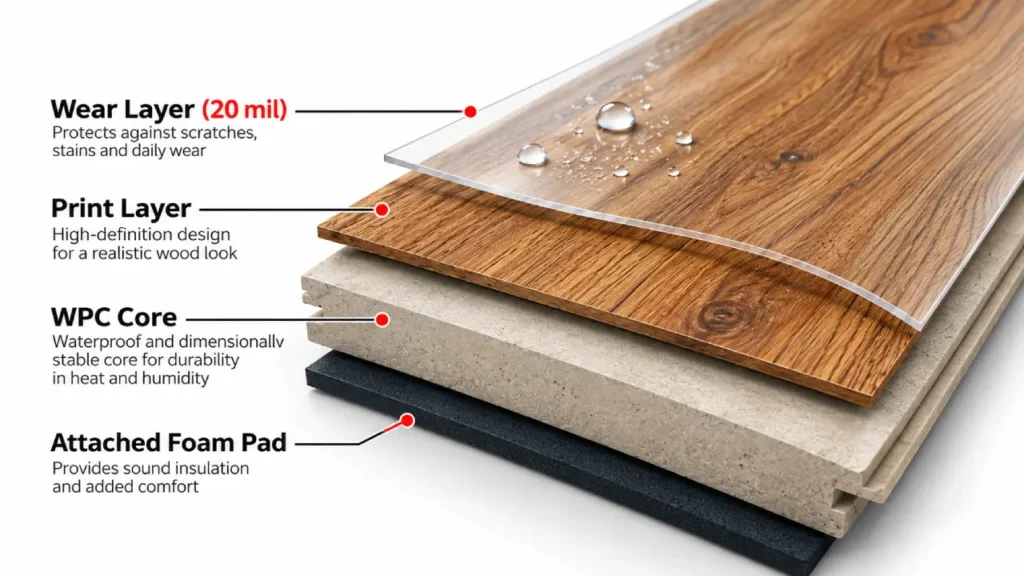
SPC means stone plastic composite. Its core combines limestone powder with vinyl, creating a dense plank that resists denting. According to BuildDirect, SPC also stays more stable than softer cores when indoor temperatures fluctuate.
WPC means wood plastic composite. Its lighter, slightly cushioned core feels warmer and quieter underfoot. The tradeoff is somewhat less stability in intense heat.
Our take? For sunny kitchens and living rooms, SPC is the stronger default. WPC earns its spot in bedrooms, where softness and quiet matter more. Manufacturers sell both as waterproof planks, but seams and the subfloor still need protection from standing water.
Busy household with dogs? Consider a wear layer of 20 mil or more. A UV resistant protective coating also helps near large windows, where direct sunlight can gradually fade cheaper vinyl. We install both through our wood flooring installation service, which also covers laminate and engineered wood.
Porcelain and Ceramic Tile
Humidity barely affects porcelain. Under the ANSI A137.1 standard, porcelain tile absorbs 0.5% water or less, measured with the ASTM C373 test. That makes porcelain ideal for bathrooms and entries.
Heat is a different story. Tile expands in direct sunlight, and rigid grout lines can’t stretch to follow that movement. That’s why the Tile Council of North America (TCNA) calls for movement joints in its EJ171 guideline. Indoors, field joints should sit no more than 25 feet apart. In direct sunlight, that limit tightens to 12 feet. Joints also belong at perimeter walls and other edges.
Clay soil adds a second risk. A shifting slab can crack rigid tile along its grout lines, especially in older homes with visible foundation movement. An uncoupling membrane or crack isolation membrane beneath the tile absorbs small movement. Most cement grout also needs sealing after installation. Before any tile flooring installation begins, we check the slab and subfloor for movement.
Laminate
Laminate places a photographic layer and a durable top coat over a high density fiberboard (HDF) core. It resists scratches and usually costs less than other popular floors. Check the AC rating, an industry classification for abrasion resistance. AC3 and above suits most residential rooms.
Water is the weak spot. Standard HDF swells when moisture sits on it for any length of time. Some newer product lines include sealed edges and water resistant cores, so read the specifications. We’d still keep laminate in bedrooms and offices.
Carpet
Engineered Hardwood
Engineered hardwood bonds a real wood veneer to a cross ply core. Because each layer resists the movement of the next, it’s far more stable than solid wood. It still moves. Just less. Keep it in living and dining rooms with consistent air conditioning, away from bathrooms.
Sunlight gradually changes the color of wood finishes. Window coverings slow that down. If you have pets, ask about the species’ Janka hardness rating, since harder woods resist claw marks better.
Which Floors Fail Most Often in Texas Homes?
Some floors look beautiful in a showroom and deteriorate here within a few summers. These are the most common problem choices.
- Solid hardwood glued straight to a slab, which cups and gaps as moisture levels shift.
- Bargain vinyl with a thin wear layer, which dents easily and fades in strong sunlight.
- Standard laminate in kitchens or laundry rooms, where one slow leak can swell the core.
- Carpet in bathrooms, where it traps moisture and eventually grows mildew.
Solid wood can work over a slab with a plywood subfloor and careful moisture control. It takes considerable extra preparation. For most families, engineered wood gives the same look with less risk.
Does Luxury Vinyl Plank Expand in the Texas Sun?
Yes, noticeably. Vinyl expands as it heats and contracts as it cools. According to Flooring Clarity, manufacturers estimate about 1/16 inch of movement per 8 to 10 feet of flooring. Small? Across a long, sunny living room with west windows, those fractions add up to a visible ridge quickly.
Three installation steps keep it flat.
- Leave an expansion gap of roughly 1/4 to 1/2 inch at walls and cabinets. Baseboards or quarter round hide it.
- Add transition strips in long runs, usually in rooms longer than about 40 feet.
- Never pin the floor under heavy kitchen islands or built-ins.
Buckling and curled edges almost always trace back to one of those installation steps. Glue down vinyl can also lose its bond when sunlight overheats the adhesive.
Sun control matters too. Blinds, low E glass and professional window film all cut the heat reaching the floor. Some rooms bake in direct sun all afternoon with bare windows and no shade from trees or neighboring homes. Porcelain is the smarter floor there.
Why Should a Concrete Slab Be Moisture Tested Before New Floors?
Because invisible moisture ruins floors. Moisture related flooring failures cost an estimated $2.4 billion a year in the US, according to Wagner Meters.
A slab can appear completely dry and still release moisture vapor. Once new flooring covers it, that vapor becomes trapped underneath. Wood cups. Vinyl bubbles. Adhesive lets go. Carpet pads grow mold.
Two standard tests measure moisture inside a concrete slab. ASTM F2170 places probes inside the concrete to read relative humidity at depth. ASTM F1869, the calcium chloride test, measures moisture leaving the surface. Wagner Meters calls the probe method the most reliable option. When readings run high, a vapor barrier or moisture mitigation system goes down first.
That’s why MNR LLC (MNR Flooring & Paint) can moisture test your slab before any installation. Testing adds a little time up front, but it can prevent a complete tear out later.
What Indoor Humidity Keeps Floors Stable?
Aim for 30% to 50% relative humidity inside your home. The EPA advises keeping indoor humidity below 60%, ideally between 30% and 50%, to help prevent mold. You can read the EPA’s guidance on indoor humidity and mold for more detail. The National Wood Flooring Association (NWFA) uses the same 30% to 50% range for wood.
Your air conditioning handles most of this work in summer. It pulls moisture out of the air as it cools. An inexpensive hygrometer shows your actual indoor reading. If it stays above 60% for several days, run a dehumidifier or schedule an HVAC inspection. Leave the air conditioning on when you travel, because a hot, closed house is hard on wood.
Acclimation matters too. New flooring should rest in the room where it’ll be installed. Many vinyl products require 24 to 48 hours. For wood, installers often check the boards’ moisture content with a meter before installation, following the manufacturer’s instructions.
What Is the Best Flooring for Each Room?
Match each floor to the water exposure and foot traffic that room receives.
- Kitchen: SPC vinyl plank or porcelain tile.
- Bathrooms and laundry: Porcelain or ceramic tile.
- Living and dining rooms: Engineered hardwood or SPC vinyl plank.
- Bedrooms: Carpet, WPC vinyl plank or laminate.
- Entry and mudroom: Porcelain tile.
- Sunny rooms with big west windows: Porcelain, or SPC with good shading.
- Rentals: SPC vinyl plank, since it cleans easily and damaged planks are simple to replace.
- Homes with pets: SPC with a thick wear layer, or porcelain.
We handle flooring installation in San Antonio for every room on this list.
Plan the Paint and Floor Order Before You Start
If walls need fresh paint too, plan the order before work starts. In most homes, painting goes first, then flooring, so paint drips never land on new floors. Our interior painting services and flooring crews work from one schedule.
How Do You Keep New Floors Looking Good in Texas Heat?
A few simple habits protect your investment.
- Vinyl plank: Sweep abrasive grit regularly and place felt pads under furniture. Some rubber backed rugs discolor vinyl, so check the label first.
- Tile: Reseal cement grout on the schedule your sealer recommends. Hairline cracks? Have them inspected. They can indicate slab movement.
- Engineered wood: Hold indoor humidity between 30% and 50%. Rotate rugs in sunny spots so the floor fades evenly.
- Carpet: Vacuum weekly and choose low moisture cleaning methods so the pad dries quickly.
The Best Flooring for Texas Heat and Humidity Comes Down to the Install
The best flooring for Texas heat and humidity is the material matched to each room’s moisture and sun exposure. For most homes, that’s SPC vinyl in living areas and porcelain in wet rooms. The carpet still belongs in bedrooms.
But the material is only half the job, because the installation decides whether a floor lasts. That means testing the slab first, then leaving the right gaps and joints.
Before we recommend any floor, we check the subfloor. MNR LLC has served San Antonio and surrounding areas for 25+ years. We’re a licensed and insured flooring and painting company. Every project comes with our workmanship guarantee and an estimate with no hidden fees.
Ready to choose your flooring? Request a free estimate or call (210) 806-0439. We’ll walk through every room with you and explain the options.